


Meet Merry Reindeer at Santa's Village (Jefferson, NH)
Take a road trip to Santa’s Village for a magical encounter with the friendliest reindeer this side of the North Pole! But first, get the inside scoop on the likes of Donner and Blitzen from Jessica Boris, Reindeer Caretaker at Santa’s Village.
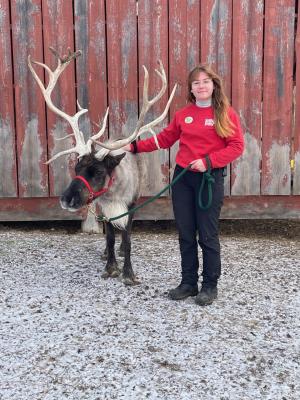 Tell us some fun facts about the reindeer at Santa’s Village.
Reindeer are the only species of deer where males and females both grow antlers.
Reindeer belong to the same animal family as New Hampshire’s native whitetail deer and moose.
Like the song, “Up on the rooftop click, click, click” a reindeer’s legs make a clicking noise when they walk, which helps herd members find each other even in blizzard conditions.
Reindeer are the only mammals which can see ultraviolet light, helping them see better when the sun is reflecting off the snow.
Reindeer do not have top front teeth and instead use a hard flat mouth palate for grinding up food.
Reindeer grow a new set of antlers every year, which are made of bone and can grow up to an inch a day.
How many reindeer are currently in the herd?
30 Reindeer
Can you walk us through a typical day of caring for the reindeer?
Each day starts with checking on the reindeer and cleaning the barn. After bringing selected deer to the Reindeer Rendezvous, I prepare their feed, do chores, and complete daily training with the younger animals. In the evening, the reindeer are returned home, fed dinner, and secured for the night.
In what ways can visitors interact with or learn about the reindeer during their visit?
Guests can visit the reindeer at the Reindeer Rendezvous, where they are welcome to photograph, pet, and feed specially rationed treats provided by Santa’s helpers. Our reindeer caretakers and the helpers at the Reindeer Rendezvous are happy to answer any reindeer questions.
Image Courtesy Santa's Village
Birding Tips from the Squam Lakes Natural Science Center (Holderness, NH)
If you are after a guaranteed wildlife sighting, the Squam Lakes Natural Science Center is the premier destination in New Hampshire. Enjoy the animal exhibit trails and keep an eye out for flitting birds, or follow the advice of Ian MacLeod, Executive Director, for other great places to go birding in the White Mountains.
 Tell us about the wildlife viewing opportunities at Squam Lakes Natural Science Center (SLNSC), including what visitors can expect on the boat tours.
The woods and meadows at the Science Center are alive with songbirds in the spring and summer. Tree Swallows, House Wrens and Eastern Bluebirds quarrel over the nesting boxes placed along the trails. On the lake, Loons are always a highlight. Squam Lake has one of the greatest nesting densities of loons in the state. Great Blue Herons are frequently seen commuting in and out of a long-established nesting rookery on an island in the middle of the lake and Bald Eagles have nested here since 2003.
Can you share a brief overview of the SLNSC mission and your role in conservation and education?
The mission of the Science Center is to Advance Understanding of Ecology by Exploring New Hampshire’s Natural World. Using the outdoors as a classroom and live native New Hampshire animals as teaching ambassadors, visitors of all ages learn about animals, the environment, and conservation as they explore open meadows, mature forests, marsh boardwalks, and trailside exhibits where native animals reside. Staff naturalists present natural history programs year-round on-site and via outreach, ranging from lake ecology classes to outdoor experiences to indoor and virtual live animal presentations. Blue Heron School, our on-site nature-based Montessori early learning center, stimulates child-focused Montessori learning with enriching outdoor experiences. Additionally, the Science Center offers year-round adult courses and workshops, lecture series, natural history trips and tours, classes for homeschool families, and outdoor adventure camps for children. Guided natural history boat tours of Squam Lake are offered from May through October.
What are some exciting animal/bird species that visitors might spot in the White Mountains region?
The White Mountain area is a haven for woodland songbirds. More than twenty species of colorful warblers arrive from the tropics in the spring to take advantage of the profusion of emerging insects (including the dreaded blackfly). A walk on any trail within the national forest on a May morning will be alive with bird song. Use the Merlin Bird ID app on your phone and you will be amazed at how many species are around you. As you climb higher, specialized boreal forest species will take over such as Boreal Chickadee, Black-backed Woodpecker, Swainson’s Thrush and the rare Bicknell’s Thrush.
Do you have any helpful birdwatching or wildlife spotting tips for beginners?
A walk out to the Pondicherry National Wildlife Refuge in Whitefield/Jefferson is always rewarding. The viewing platform overlooking Cherry Pond is always a great spot to view wildlife. A canoe paddle on Lake Umbagog in Errol will really immerse you in a North Country experience. Join a bird walk at Quincy Bog in Rumney. In addition to the bird-viewing, moose watching is also a thrilling experience, and multiple companies offer guided evening tours throughout the White Mountain region.
Image Courtesy Squam Lakes Natural Science Center